
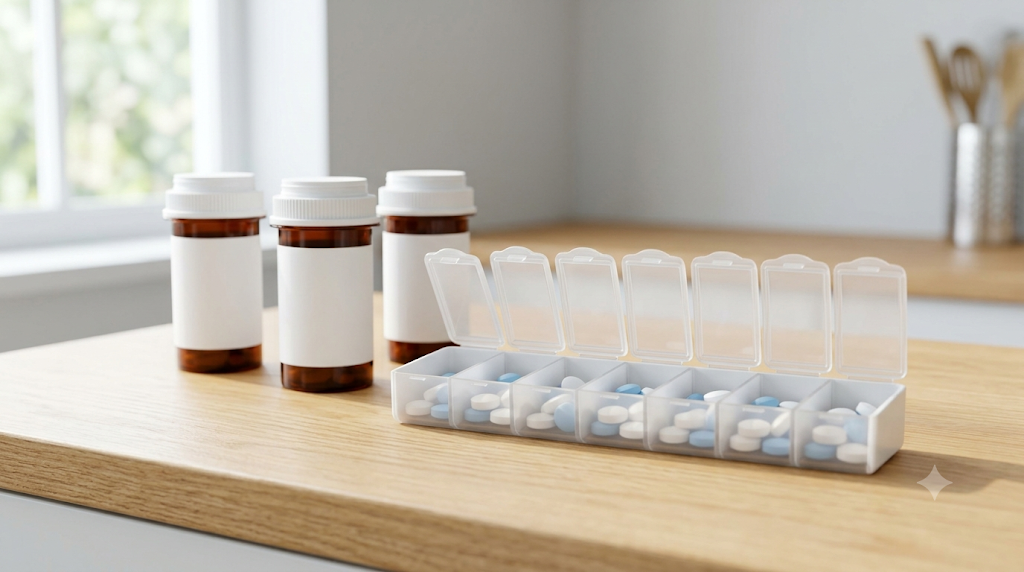
The most reliable way to keep track of multiple prescriptions is to build one written medication list, use a weekly pill organizer filled on the same day each week, and sync all your refills to a single pickup or delivery date. Those three habits work together. The list prevents mix-ups at appointments, the organizer catches missed and doubled doses, and refill sync removes the guesswork about when each bottle runs out. Your pharmacist can set the sync up for you. At Greenleaf Pharmacy in Park City, that includes free next-day delivery across Illinois, so one date can cover everything. The rest of this article covers how to build the list, which tracking method fits your situation, and the mistakes that cause most problems.
Why Tracking Multiple Prescriptions Matters
Taking several medications is normal, and it raises the odds of small errors.
Data from the National Center for Health Statistics shows that among United States adults aged 40 to 79, 69.0% used at least one prescription drug in the past 30 days and 22.4% used five or more. Adults aged 60 to 79 were more than twice as likely as those aged 40 to 59 to be taking five or more. Among adults 60 and over, 85% used at least one prescription drug in the past month.
Errors are common once the count climbs. A report published by the Centers for Disease Control and Prevention in its Morbidity and Mortality Weekly Report found that around 1 in 5 new prescriptions are never filled, and among those that are filled, roughly 50% are taken incorrectly, most often in timing, dosage, frequency, or duration.
The consequences are measurable. A study published in the New England Journal of Medicine estimated 99,628 emergency hospitalizations each year for adverse drug events among United States adults aged 65 and older. Nearly two thirds of those hospitalizations came from unintentional overdoses, and four medications or medication classes accounted for about 67% of them.
How to Build a Medication List That Works
One list, kept current, is the foundation. Keep a copy in your wallet and a photo on your phone.
| What to record | Why it matters |
| Brand and generic name | Two names for one drug is a common source of accidental doubling |
| Strength and dose | The prescriber needs the number, not just the drug name |
| How often and what time | Timing errors are among the most frequent mistakes |
| Reason you take it | Helps you spot medications that may no longer be needed |
| Prescribing doctor | Refill requests go faster when the pharmacy knows who to call |
| Start date | Useful when a new symptom appears |
| Over-the-counter items and supplements | Vitamins, pain relievers, and herbal products can interact with prescriptions |
| Allergies and past reactions | Prevents a repeat of a drug you did not tolerate |
Update the list every time something changes. A list that is six months old causes the same problems as no list.
Which Tracking Method Should You Use
There is no single best method. Match the tool to how many medications you take and how complicated the schedule is.
| Method | Works well for | Limitations |
| Written or printed list | Everyone, as the base layer | Only helps if you keep it updated |
| Weekly pill organizer | Multiple daily doses, morning and evening splits | Not suitable for medications that must stay in original packaging |
| Phone alarms | Doses at specific times | Easy to dismiss and forget |
| Text message reminders | People who respond to prompts | Works better with a reply or check-in built in |
| Medication app | Many medications with varied schedules | Requires you to enter everything accurately |
| Refill synchronization | Three or more long-term prescriptions | Needs a short setup call with your pharmacy |
| Adherence packaging | Complex schedules, caregivers helping | Ask your pharmacy which medications can be packaged this way |
One honest caution about devices. A randomized trial of 53,480 patients published in JAMA Internal Medicine, known as the REMIND trial, mailed low-cost reminder devices to people with poor adherence, including a standard pillbox, a digital timer cap, and a pill bottle strip. After 12 months, none of the devices improved adherence compared with no device at all. The researchers concluded that low-cost devices by themselves did not measurably improve how people took their medications.
The lesson is not that pill organizers are useless. It is that a tool works when it is part of a routine, with a fixed filling day, a set place to keep it, and a pharmacist who knows your full list.
How to Set Up a Weekly Pill Organizer Safely
- Pick one filling day and time. Sunday morning works for many people because it is easy to remember.
- Work from your medication list, not from memory. Check each bottle label against the list.
- Fill one medication at a time, across all days. Finish the blood pressure tablet for all seven days before moving to the next drug. This prevents skipped compartments.
- Separate morning, midday, and evening. Use an organizer with the compartments you actually need.
- Keep the original bottles. You need the labels for refills, doses, and appointments.
- Ask before you transfer anything. Some medications lose stability outside their packaging, and some tablets should never be split or crushed. Your pharmacist can tell you which ones.
- Store it somewhere dry and out of reach of children. Heat and humidity affect many medications.
If a dose is missed, do not double up to catch up. Call the pharmacy and ask what to do for that specific drug.
How Refill Synchronization Simplifies Multiple Prescriptions
Refill synchronization aligns all your long-term prescriptions so they are ready on the same day each month. Instead of five separate trips and five different run-out dates, there is one.
The evidence supports it. A study published in Health Affairs compared nearly 23,000 propensity-matched patients and found that those in a synchronization program had a mean proportion of days covered of 0.87, compared with 0.84 for patients without one. The improvement was three times greater among patients who started with low adherence, which is exactly the group that struggles most with several bottles on different cycles.
Setting it up usually takes one conversation. The pharmacy reviews your prescriptions, adjusts quantities once so everything lines up, then contacts you before each cycle. You can transfer your prescriptions to one pharmacy first, which makes syncing far simpler, and delivery can bring the whole month to your door.
What to Bring to Every Doctor Appointment
Bring the list, and bring the bottles if the list is out of date. Also mention:
- Anything you stopped taking and why
- Side effects you noticed, even mild ones
- Over-the-counter products you use regularly, including pain relievers, antacids, and sleep aids
- Vitamins, minerals, and herbal supplements
- Any medication you are splitting, skipping, or taking differently than the label says
That last point matters most. If cost or side effects have you taking less than prescribed, say so. There are often alternatives, including different strengths, generics, or a compounded formulation when a standard product does not suit you.
Mistakes to Avoid When Managing Several Medications
- Relying on memory alone. Forgetfulness is the most common reason doses are missed.
- Using two pharmacies without telling either one. Interaction checks only work when one system sees everything.
- Assuming brand and generic are different drugs. This is a frequent cause of accidental double dosing.
- Leaving over-the-counter products off your list. Many contain the same active ingredients as prescriptions. Ask about your over-the-counter medications when you pick up refills.
- Waiting until the last tablet to request a refill. Order when about a week remains.
- Stopping a medication on your own. Talk to the prescriber first, even if you feel fine.
Final Thoughts
Keeping track of multiple prescriptions comes down to a system rather than willpower. Write one list and keep it current. Fill a weekly organizer on the same day each week, using the labels rather than memory. Sync your refills so everything arrives together, which research links to better adherence, especially for people who have struggled with it before. And use one pharmacy so a pharmacist can see your full picture and catch problems early.
If you are managing several medications and the schedule has become hard to follow, contact the Greenleaf Pharmacy team or call the Park City pharmacy and ask for a medication review and refill sync.